
Identify Noise at the Workplace – A Simple Guide
Identifying Excessive Noise is the Key Step in Noise Risk Assessment (NRA)
The identification of excessive noise is a crucial preliminary step before conducting a Noise Risk Assessment (NRA) in any workplace. This process allows employers to pinpoint which employees may be at risk of exposure to harmful noise levels, ensuring that appropriate protective measures can be implemented.
Importance of Employee Involvement in Noise Identification
Effective noise identification relies on the active participation of employees who are familiar with the specific operations, processes, and work environments.
These are individuals who regularly work in areas where noise levels might be problematic. By engaging these employees, employers can gather valuable insights into the noise levels present in different parts of the workplace.
Systematic Noise Identification Process
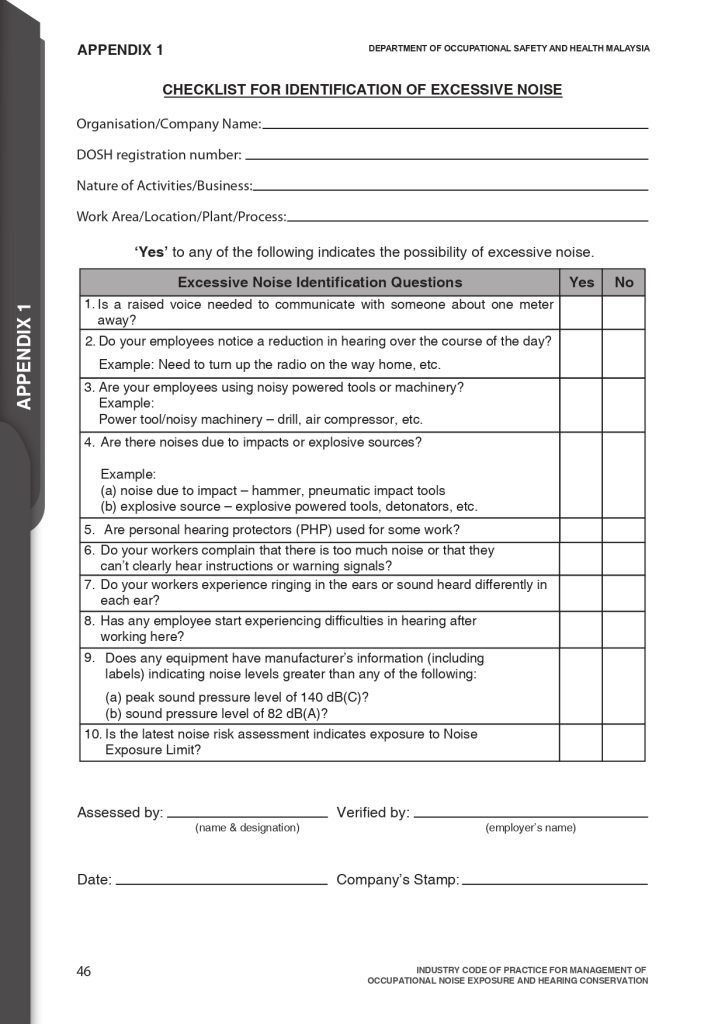
The identification process is systematically conducted across all areas of the workplace, taking into account the nature of activities in each zone. This is achieved using a comprehensive checklist provided in the Industry Code of Practice (ICOP) for Management of Occupational Noise Exposure and Hearing Conservation, specifically in Appendix 1.
This checklist serves as a standardized tool for evaluating noise levels and determining if they exceed safe thresholds. Note that the identification of excessive noise at the workplace must be conducted by personnel familiar with the work process and verified by the employer.
Examples of Work Natures with Noise Sources
Certain types of work are more likely to generate excessive noise, requiring careful monitoring and assessment. Some examples include:
- Manufacturing and Production Lines – Operations involving heavy machinery, such as stamping presses, grinding machines, or assembly lines, often produce significant noise levels. Continuous exposure to these sounds can pose a risk to workers.
- Construction and Demolition Work – Activities like drilling, hammering, and the use of power tools generate high noise levels. Workers in construction environments are frequently exposed to hazardous noise conditions.
- Aviation and Airports – Ground handling of aircraft, including engine testing, maintenance, and aircraft movement, produces loud noise. Personnel working on runways or in maintenance areas need to be cautious about their exposure.
- Mining Operations – The use of explosives, drilling equipment, and large machinery in mining can result in dangerously high noise levels, necessitating strict monitoring and control measures.
- Textile Manufacturing – The operation of looms, spinning machines, and other textile machinery generates a continuous, high-decibel noise environment. Workers in these settings are at risk of hearing damage if proper precautions are not taken.
When to Conduct a Noise Risk Assessment
If the identification process, as outlined in the checklist, reveals the presence of excessive noise, an NRA is mandatory. Additionally, any significant changes in the workplace necessitate a re-identification of noise levels.
Such changes may include modifications to machinery, equipment, processes, work patterns, control measures, or operations. If these changes suggest a potential increase in noise levels, an NRA must be conducted to reassess the risk.
Examples of Workplace Changes Requiring Re-Identification
- Workplace changes that could impact noise levels include:
- Installation, modification, or removal of machinery.
- Changes in workload or operating conditions of equipment that may significantly alter noise levels.
- Structural changes in buildings that could influence acoustics and noise distribution.
- Modifications in work arrangements that affect the duration employees spend in noisy environments.
Regular Re-Identification of Noise Levels
Even if initial identification indicates no excessive noise exposure, employers are required to re-identify noise levels at least once a year. This ongoing monitoring ensures that any changes in the work environment are promptly addressed, maintaining a safe workplace for all employees.